- English
- French
- German
- Portuguese
- Spanish
- Russian
- Japanese
- Korean
- Arabic
- Greek
- German
- Turkish
- Italian
- Danish
- Romanian
- Indonesian
- Czech
- Afrikaans
- Swedish
- Polish
- Basque
- Catalan
- Esperanto
- Hindi
- Lao
- Albanian
- Amharic
- Armenian
- Azerbaijani
- Belarusian
- Bengali
- Bosnian
- Bulgarian
- Cebuano
- Chichewa
- Corsican
- Croatian
- Dutch
- Estonian
- Filipino
- Finnish
- Frisian
- Galician
- Georgian
- Gujarati
- Haitian
- Hausa
- Hawaiian
- Hebrew
- Hmong
- Hungarian
- Icelandic
- Igbo
- Javanese
- Kannada
- Kazakh
- Khmer
- Kurdish
- Kyrgyz
- Latin
- Latvian
- Lithuanian
- Luxembou..
- Macedonian
- Malagasy
- Malay
- Malayalam
- Maltese
- Maori
- Marathi
- Mongolian
- Burmese
- Nepali
- Norwegian
- Pashto
- Persian
- Punjabi
- Serbian
- Sesotho
- Sinhala
- Slovak
- Slovenian
- Somali
- Samoan
- Scots Gaelic
- Shona
- Sindhi
- Sundanese
- Swahili
- Tajik
- Tamil
- Telugu
- Thai
- Ukrainian
- Urdu
- Uzbek
- Vietnamese
- Welsh
- Xhosa
- Yiddish
- Yoruba
- Zulu
Why Taxi Three Wheeler Vehicles Are Popular for Urban and Short-Distance Transport?
Three-wheeled taxi vehicles have become very popular in cities all over the world because they make it easier to get around in crowded cities. These small, easy-to-maneuver cars fill the important gap between public transportation systems and final destinations, providing eco-friendly, cost-effective ways to connect the last mile. Traditional four-wheeled vehicles have a challenging time getting through narrow streets and heavy traffic, but scooters can. They also have lower operating expenses than sedans, which makes them a good choice for fleet operators and city governments looking for green ways to get around cities. As cities deal with smog and traffic, the three-wheeled taxi appears to be a smart way to get around in cities today.
Understanding Taxi Three Wheelers: Definition, Functionality, and Advantages
What Defines a Three-Wheeled Taxi?
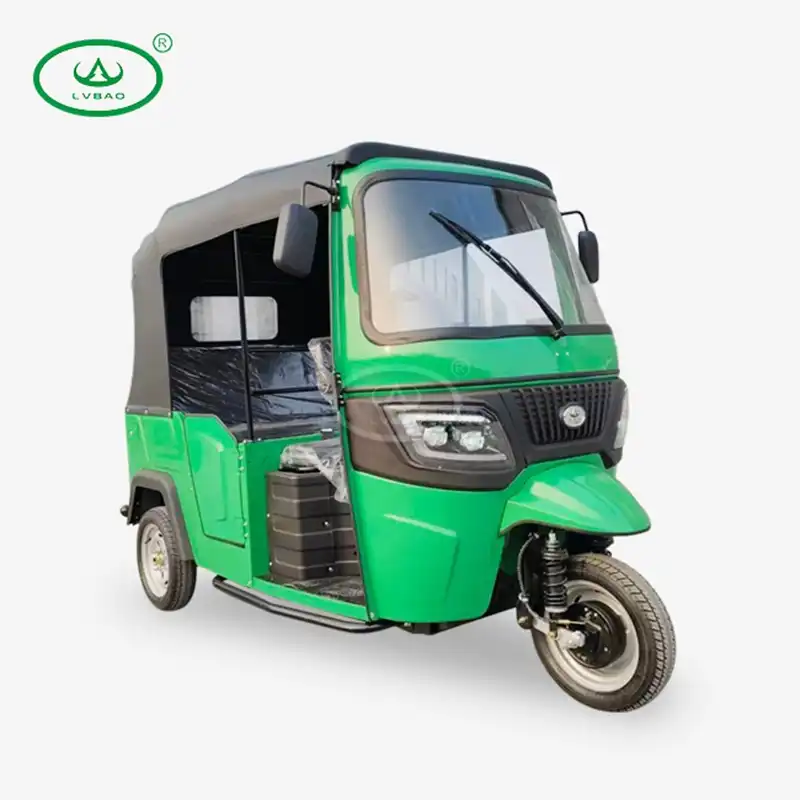
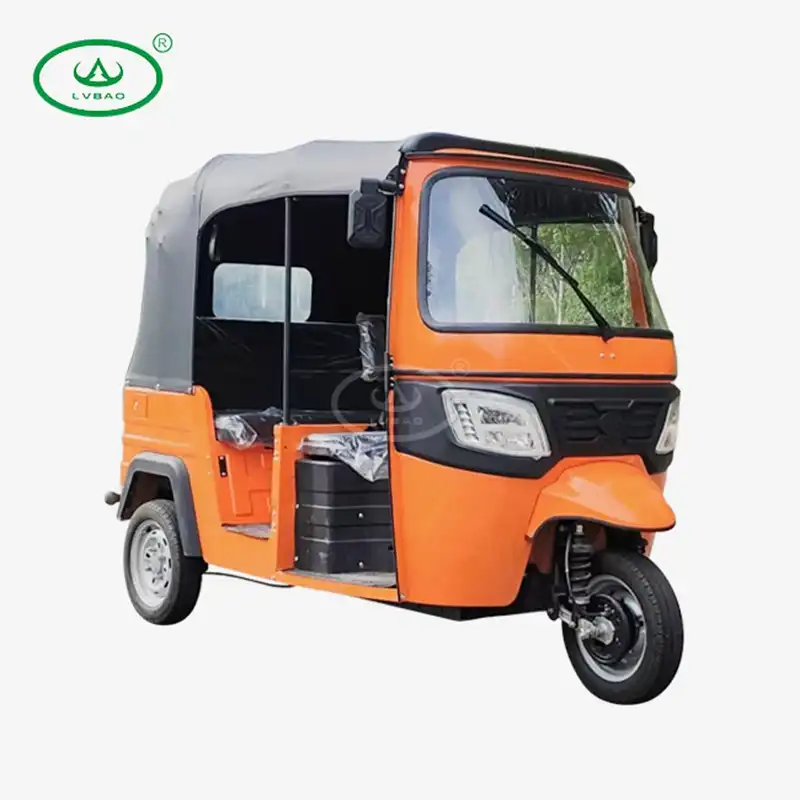
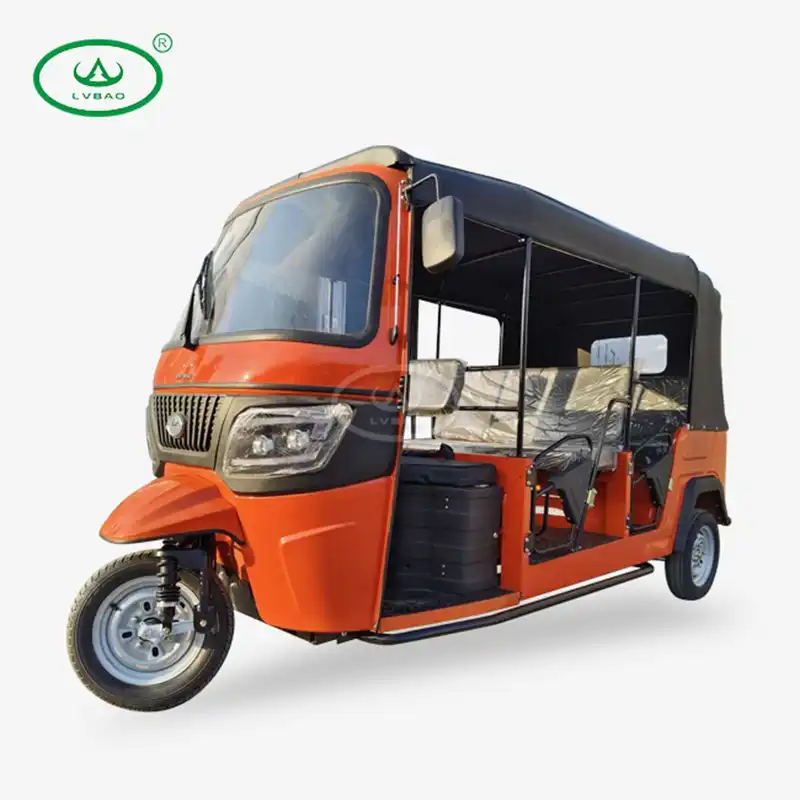
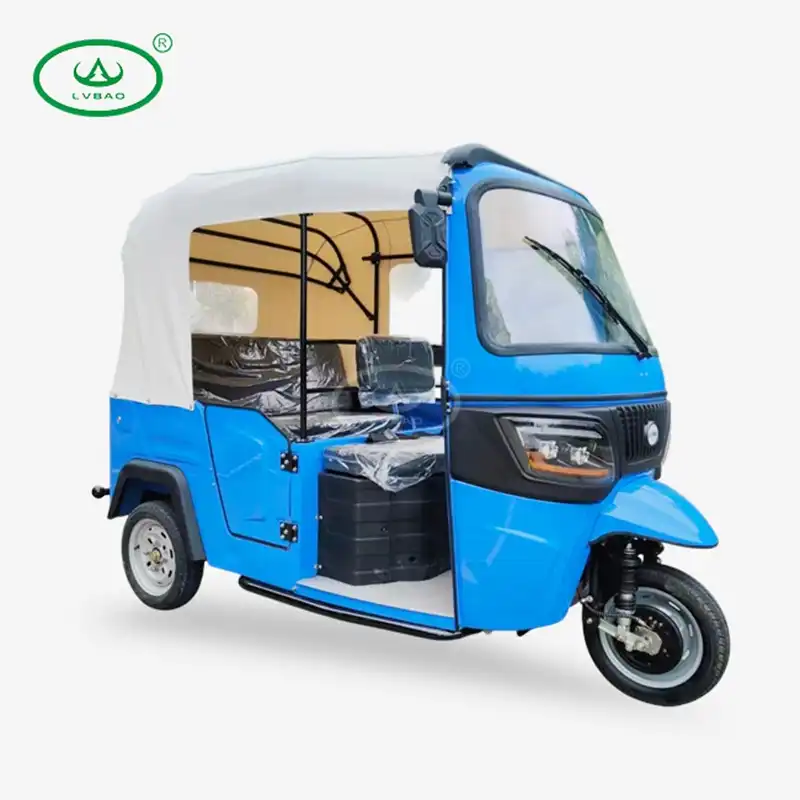
As an L5-category passenger car, a three-wheeled taxi is designed for high-frequency transit operations in cities and suburbs. Professional-grade models, on the other hand, have stronger chassis designs, more advanced suspension systems, and safety features that meet foreign approval standards. The main structure of the vehicle is usually made of a high-tensile welded steel frame that strikes a balance between strength and weight, making it a platform that can be used for business purposes in tough urban settings. Modern electric versions, like those made by Lvbao, use 60/72V 4500W AC asynchronous motors and 72V 160Ah lithium battery systems. They work reliably and can reach speeds of up to 60 km/h, which is great for urban transit routes.
Key Technical Attributes Driving Performance
Three-wheeled taxis are highly engineered, and their success depends on a few key parts. When you mix a double wishbone spring fork front suspension system with an automotive-grade constant velocity joint-type independent shock absorber transmission, you get stability on rough city streets. Its small total size—about 3435×1350×1850 mm—allows for tight turning radii of less than 3.5 meters, which lets drivers get through busy streets and tiny alleyways that bigger vehicles can't go through. The front and back drum-type hydraulic brakes, along with foot-operated mechanical parking devices, make sure that passengers are safe, even when the vehicle is fully loaded. These technical specs directly lead to operational benefits, such as less downtime for vehicles, more comfortable seats for passengers, and compliance with strict international safety standards, such as ISO 9001:2015 manufacturing processes.
Cost-Effectiveness and Environmental Benefits
When procurement managers look at the make-up of their fleets, the cost savings of three-wheeled cars are instantly clear. When you buy an electric car, you don't have to pay for gas at all; instead, you pay much less for power. Compared to internal combustion engines, maintenance periods are much longer. For example, you usually need small repairs every 5,000 km instead of every 3,000 km, as with traditional engines. The corrosion-resistant steel frame design means that it will last for 10 to 12 years in business settings, giving you the best return on your investment. In addition to saving money, the environmental impact is minimal. Electric models with zero tailpipe pollution help cities meet their sustainability goals and help owners follow the stricter emission rules in cities. Because they are both environmentally friendly and beneficial for the economy, the cars are the best choice for smart city building projects.
Comparing Three-Wheeled Taxis with Other Urban Transport Options
Three Wheelers Versus Traditional Auto Rickshaws
Traditional auto rickshaws were the first small vehicles for getting around cities, but modern three-wheeled taxis represent a significant technological advancement. Traditional models often use old two-stroke engines that don't get good gas mileage and put out a lot of pollution. Newer electric three-wheeled taxis, on the other hand, have better power and are almost completely quiet when they're running. The difference can be measured: compared to gasoline-powered rickshaws, electric versions have a total cost of ownership that is about 60–70% lower over five years. The passenger experience also improves a lot. Better suspension systems reduce vibrations, and large rooms with comfortable seats meet the needs of all kinds of passengers. This comparison makes it clear that advanced three-wheeled taxi technology is better for government bid officers and local project experts who are looking at ways to update public transportation.
Electric Versus Petrol Variants
Electric power is clearly the way the business is going. The costs of running three-wheeled taxis driven by gasoline are going up because fuel prices are going up and down and emission standards are getting stricter in developed markets. Electric models get rid of these weaknesses and add benefits that are specific to urban usage. Battery management systems make it possible to plan a reliable range—usually 80 to 120 km per charge, though the figure depends on load and terrain—which is enough for daily commutes in cities. Adding charging stations to smart towns makes them even more useful, and adding solar charge piles makes them a sustainable source of energy. Electric drivetrains are easier to maintain, which means that transport and last-mile delivery businesses can keep their fleets more available and spend less on technology, both of which directly affect their profits.
Positioning Against Small Cars and Sedans
While small four-wheeled vehicles can carry more people, they give up the mobility and cost benefits that make three-wheeled taxis useful. Three-wheeled taxis are particularly advantageous because they don't take up much room, which is important in heavily populated urban areas where parking is expensive. The operational economics of the two are completely unique. For example, a three-wheeled taxi uses about one-third as much energy per kilometer as a small car, but it takes up half as much road space. These things add up to big competitive benefits for fleet managers who work in areas with a lot of vehicles. The unique design makes the car work best in situations where regular cars don't do well, like short trips through heavy traffic, making many stops, and working in places with few infrastructure options.
Procurement Considerations for Three-Wheeled Taxis in B2B Context
Essential Evaluation Criteria
To make sound buying choices, you need to carefully look at a lot of different success factors. The total cost of ownership, which includes things like energy use, upkeep frequency, spare parts availability, and estimated service lifespan, is something that buying managers must look at in addition to the base price. For electric models, battery performance is especially important. Operators should check the expected service life, the ability to control temperature, and the warranty's coverage for replacing batteries. Payload capacity rates must match the planned use cases. For example, vehicles used for transporting people usually need to be able to hold 300–400 kg, while freight vehicles used for transporting goods may need to be able to hold 500–600 kg. Another thing that can't be changed is certification compliance. Vehicles must possess the appropriate safety certifications for their intended markets, including EEC licenses for European use or equivalent standards for American use.
Financing Strategies and Supply Chain Partnerships
Capital allocation tactics significantly affect the speed of fleet deployment and the company's finances. An outright buy has long-term cost benefits and gives you ownership of the object, but it requires a big down payment. Leasing agreements help businesses keep their operating cash and give them practical freedom, but the total cost over the term of the lease usually exceeds the cost of buying the business. Bulk purchasing agreements with makers like Lvbao can get you discounts and faster shipping times for big-city projects or the growth of your logistics network. When you form long-term strategic relationships with certified suppliers, you get stable supply chains, access to expert support networks, and first choice for new products. Engineering managers should give more weight to sellers who have a strong after-sales service infrastructure, such as spare parts that are easy to find and area service centers that can keep vehicles running as much as possible.
Supplier Qualification and Quality Assurance
To find trustworthy makers, you need to look into their production skills, approval portfolios, and past work on government or large-scale projects. Suppliers should show that they follow ISO 9001 standards for quality management, ISO 14001 standards for environmental protection, and ISO 45001 standards for workplace safety. It doesn't matter how much you can make; factories that are bigger than 200,000 square meters and have combined painting, pressing, and assembly lines show that they are on an industrial scale and that their production is stable. When operators need customized setups to deal with specific operating situations, OEM and ODM skills become useful. As part of quality control, the frame weld must be checked for integrity, the performance of the dynamic brakes must be confirmed, the thermal stability of the battery management system must be checked, and the resistance to rust from salt spray must be tested for more than 500 hours. These strict evaluation criteria separate professional-grade suppliers from low-quality makers. This protects buying investments and makes sure that the fleet is reliable.
Operational and Maintenance Tips for Maximizing Taxi Three-Wheeler Efficiency
Routine Service Schedules and Preventive Care
To maximize a vehicle's lifespan, it needs to be maintained according to the manufacturer's instructions. Every 5,000 km, electric three-wheel taxis need to have their structure inspected and their battery management system checked to make sure the connections are solid, the heat sensors work, and the charge levels are even across all of the cells. Regular checks should be done on mechanical parts like brakes, suspension, and tires. For example, brake pad thickness should stay within certain limits, and hydraulic fluid levels should be checked every month. Periodic rust checks are beneficial for the welded steel frame, especially for cars that work near the coast or in places with a lot of humidity, where salt exposure speeds up corrosion. Setting up repair plans based on real usage trends instead of random time intervals is the best way to make the best use of resources and avoid sudden failures that lower fleet availability.
Enhancing Energy Efficiency and Reducing Emissions
Best methods for operations have a direct effect on how much energy is used and how it affects the world. If you change the way you drive, you can see measured gains. For example, if you drive slowly at first, then quickly, and keep your speed between 45 and 50 km/h for most electric cars, you can increase your range by 15-20% compared to aggressive driving styles. Keeping tire pressure at the amounts recommended by the maker lowers rolling resistance. Aligning wheels regularly stops them from wearing out too quickly and wasting energy. For mixed companies that still have gasoline models, switching to electric models is the most effective way to cut down on emissions because they don't produce any engine pollutants and are quieter, which is important for operations in residential areas and at night.
Safety Protocols and Technology Integration
Passenger safety goes beyond following the rules and becomes a way for business providers to stand out from their competitors. Many manufacturers build safety technologies into modern three-wheeled taxis. Automotive-grade drum-type hydraulic braking systems make sure they stop reliably, and low center-of-gravity designs lower the risk of rolling over when turning. Newer models have anti-roll bars and better front wheel design that keep the bike from tipping over, even when turning quickly with many people on board. Driver training programs that focus on careful driving, communicating with passengers, and emergency response methods improve safety in ways that go beyond the design of the vehicle itself. Operators should use telematics systems to keep an eye on driver behavior, car performance measures, and route efficiency. These systems should provide data analytics to help improve safety and keep records for regulatory authorities.
Future Trends and Opportunities in the Three-Wheeler Taxi Market
Electric Drivetrain Innovations and Smart Connectivity
In many areas, technological progress is accelerating. Next-generation battery chemistries offer energy levels that are 30–40% higher than current lithium-ion standards. This will increase operating ranges while lowering charging times. Although solid-state battery technology is still new, it has better safety ratings and is expected to last longer, possibly up to 5,000 charge cycles. When three-wheeled taxis connect to smart vehicles, they become data-generating platforms that fully integrate with urban mobility environments. Fleet managers can improve working efficiency with real-time position tracking, predictive maintenance alerts, and route optimization algorithms. Integration with IoT platforms makes it possible for traffic management systems, automatic delivery protocols, and digital payment infrastructures to work together flawlessly. This updates the user experience and makes back-end operations run more smoothly.
Regulatory Environment and Market Growth Projections
Environmental laws are making electric transportation options more popular in developed markets. European pollution standards and clean air programs at the state level in the United States make it crucial for fleet owners to obey the rules, which pushes them toward zero-emission options. Government incentive programs, such as purchase discounts, tax credits, and preferred licenses for electric commercial vehicles, make the market more viable and speed up the time it takes for electric cars to become common. Market research indicates that the three-wheeler taxi segment will continue to grow, especially in developing economies that are urbanizing quickly and need cheap, scalable transportation options. These trends mean that marketers and importers of new energy vehicles have many business possibilities. Distributors can take advantage of rising market demand by teaming up with makers that have strong research and development (R&D) skills, experience with foreign certification, and flexible OEM/ODM production capacity.
Strategic Positioning for Autonomous and Shared Mobility
Autonomous driving technology coming together with three-wheeled taxi systems is the next big thing in urban transport. Current semi-autonomous features like systems that help you stay in your lane, collision prevention systems, and automatic parking pave the way for fully driverless operations. Autonomous three-wheeled taxi teams have many benefits for city governments and companies that offer smart city solutions. They don't need workers, can run 24 hours a day, and use AI-powered algorithms to find the best routes. Adding three-wheeled taxis to app-based platforms for shared mobility models increases access while increasing vehicle usage rates. Assets that would normally sit idle for 20 to 22 hours a day in single-operator models can be used 60 to 70 percent of the time in shared systems. For these new business models to work, cars need to be built to last many miles and come with telematics infrastructure that supports fleet control systems.
Conclusion
Due to their unique mix of agility, cost effectiveness, and environmental sustainability, three-wheeled taxi vehicles have become an essential part of modern city transportation. New developments in electric propulsion and smart design improve passenger safety and operating efficiency, making these cars the best answers to the last-mile connectivity problems that plague crowded cities. When procurement workers and fleet managers strategically invest in modern three-wheeled taxi technology, especially electric models that meet international certification standards, they can see a positive impact on the total cost of ownership, compliance with regulations, and passenger happiness. As more people move to cities and stricter rules on the environment are enforced, the market is expected to keep growing. This means that companies that can show they have strong R&D skills and output scale will be able to work together.
FAQ
What is the expected operational lifespan of a three-wheeled taxi chassis?
If workers follow the maintenance plans, professional-grade three-wheeled taxis made with high-tensile welded steel frames should last between 10 and 12 years in business settings. Corrosion-resistant frame materials and automotive-grade parts keep the structure strong even when users operate it at high frequencies all the time. Weld points and protective coats last longer when you check them regularly, especially on cars that work in harsh environments. Fleet managers who follow strict maintenance routines report that chassis-related breakdowns are rare over the course of a working lifespan. This supports the idea that well-designed business platforms last longer.
How do electric three-wheelers perform on steep inclines with full passenger loads?
Electric models made for business use have high-torque gear ratios that give them gradeability scores between 18 and 22%. This allows people to use them safely on steep urban slopes. The AC asynchronous motors provide steady torque over a wide range of RPM, keeping up performance even when the load is full, which is a problem for standard engines. Battery management systems make sure that the right amount of power is delivered when climbing, but operators should be aware that prolonged hill climbing lowers the total range compared to operating on flat ground. For places with significant changes in elevation, you should set the motors at 4500W or higher to ensure there is enough power.
What maintenance intervals do electric three-wheeled taxis require?
Electric models need structural checks and diagnostics for the battery management system about every 5,000 km, which is a lot less often than the 3,000 km gaps that are typical for models with internal combustion engines. Electric three-wheeled taxis require maintenance such as brake system checks, tire assessments, and securing electrical connections, unlike gasoline engines that need oil changes and filter replacements. This easier maintenance profile lowers operations complexity and total cost of ownership while increasing vehicle uptime, which is critical for business operators whose income depends on their vehicles' availability.
Are replacement parts readily available for international markets?
Reputable automakers make cars with standard parts that meet ISO and E-mark standards. This makes sure that new parts are easy to find on foreign markets. Important parts like tires, LED lighting systems, brake assemblies, and electrical parts all use standard specs that work with existing supply lines. When procurement managers look at different sources, they should make sure that parts are available in the places they want to sell to and that the warranty terms are clear. Manufacturers with established distributor networks and regional service centers can offer better customer service than sellers who don't have international infrastructure. This lowers the risk of downtime for fleet owners.
Partner with Lvbao for Advanced Taxi Three-Wheeler Solutions
Changzhou Lvbao Electric Technology, a well-known high-tech company in China, appears on the MIIT list and specializes in making new electric vehicles. Our production space is over 410,000 square meters and includes several buildings with modern pressing, welding, painting, and assembly lines run by more than 500 technical experts. We have more than 40 utility model patents and are certified by ISO 9001, ISO 14001, and ISO 45001 to make sure that quality management and environmental duty are upheld throughout the production process. Our three-wheeled taxi for sale has cutting-edge features like 60/72V 4500W AC asynchronous motors, automotive-grade CV joint suspension systems, and corrosion-resistant welding steel frames that are built to last 10 years or more. Lvbao offers reliable goods and a lot of help after the sale, whether you need OEM manufacturing, ODM customization, or full smart city mobility solutions. Get in touch with us at ken@lvbaoev.com to discuss your fleet needs and find out how our technology-driven method can help your urban transportation operations run more smoothly.
References
1. International Association of Public Transport (UITP), "Sustainable Urban Mobility: Three-Wheeled Vehicles in Metropolitan Transit Systems," Annual Conference Proceedings, 2022.
2. Anderson, M. & Thompson, R., "Comparative Analysis of Last-Mile Transportation Solutions in Dense Urban Environments," Journal of Urban Mobility Research, Vol. 34, No. 2, 2023.
3. Global Electric Vehicle Outlook Committee, "Market Trends and Technological Advances in Light Electric Vehicles," International Energy Agency, 2023.
4. Zhang, L. & Patel, S., "Total Cost of Ownership Analysis for Commercial Electric Three-Wheelers," Transportation Economics Quarterly, Vol. 18, Issue 4, 2023.
5. European Commission Directorate-General for Mobility and Transport, "Regulatory Framework for L-Category Vehicles: Safety Standards and Emission Requirements," Official Policy Document, 2022.
6. Kumar, A., Singh, H. & Martinez, C., "Autonomous Technologies in Compact Urban Vehicles: Integration Challenges and Opportunities," Smart Cities Technology Review, Vol. 7, No. 3, 2024.
Tell us your requirements – get a tailored quote and technical support within 24 hours.