- English
- French
- German
- Portuguese
- Spanish
- Russian
- Japanese
- Korean
- Arabic
- Greek
- German
- Turkish
- Italian
- Danish
- Romanian
- Indonesian
- Czech
- Afrikaans
- Swedish
- Polish
- Basque
- Catalan
- Esperanto
- Hindi
- Lao
- Albanian
- Amharic
- Armenian
- Azerbaijani
- Belarusian
- Bengali
- Bosnian
- Bulgarian
- Cebuano
- Chichewa
- Corsican
- Croatian
- Dutch
- Estonian
- Filipino
- Finnish
- Frisian
- Galician
- Georgian
- Gujarati
- Haitian
- Hausa
- Hawaiian
- Hebrew
- Hmong
- Hungarian
- Icelandic
- Igbo
- Javanese
- Kannada
- Kazakh
- Khmer
- Kurdish
- Kyrgyz
- Latin
- Latvian
- Lithuanian
- Luxembou..
- Macedonian
- Malagasy
- Malay
- Malayalam
- Maltese
- Maori
- Marathi
- Mongolian
- Burmese
- Nepali
- Norwegian
- Pashto
- Persian
- Punjabi
- Serbian
- Sesotho
- Sinhala
- Slovak
- Slovenian
- Somali
- Samoan
- Scots Gaelic
- Shona
- Sindhi
- Sundanese
- Swahili
- Tajik
- Tamil
- Telugu
- Thai
- Ukrainian
- Urdu
- Uzbek
- Vietnamese
- Welsh
- Xhosa
- Yiddish
- Yoruba
- Zulu
Under the Wave of AI Technology, Autonomous Vehicles Will Reshape Logistics and Distribution
The wave of AI (artificial intelligence) technology is sweeping in, and the logistics industry stands at the forefront of transformation. With the rise of intelligent transportation tools such as autonomous vehicles and drones, traditional logistics and distribution models are being reconstructed. Leading players including Cainiao, JD Logistics, SF Express, and Meituan are gradually increasing their investment in AI implementation within logistics scenarios.。
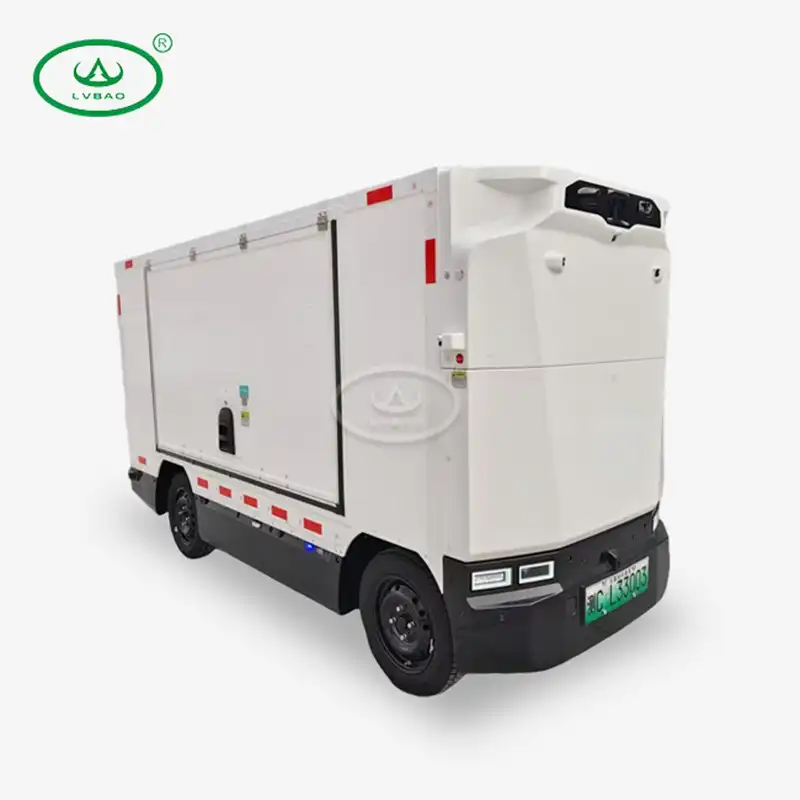
International consulting firm McKinsey predicts that 80% of parcel deliveries will be conducted through automatic distribution in the next decade; by 2025, annual sales of low-speed autonomous vehicles in China will reach 190,000 units, of which 80,000 will be in the logistics and distribution sector, becoming the largest application market.
What challenges still exist in the practical application of autonomous vehicle delivery? What role will autonomous vehicle technology play in the future logistics industry? AI large models and Wei Jigang, Deputy Director and Research Fellow of the Market Economy Research Institute at the Development Research Center of the State Council, provide their respective answers.
AI Looks to the Future: The Development Trend of Autonomous Vehicles Is Irreversible
What exactly is the future development trend of autonomous vehicle delivery? Kimi, the AI large model developed by Moonshot AI, offers its prediction:
The development trend of autonomous vehicle technology in the future logistics industry is irreversible, representing the future direction of logistics automation and intelligence. As technology matures, autonomous vehicles will play important roles in improving delivery efficiency, reducing operating costs, and enhancing service stability. It is expected that in the future, autonomous vehicles will be widely applied in urban delivery, warehouse internal transportation, "last-mile" delivery, and other fields, becoming an important component of the logistics industry.
The difficulties and challenges facing autonomous vehicle development mainly include technology maturity, regulations and policies, cost control, and social acceptance.
Autonomous vehicles will reshape the future of the logistics industry from multiple levels. First, they will change the operational model of logistics distribution, achieving more efficient cargo circulation. Second, the application of autonomous vehicles will promote the digital transformation of the logistics industry, optimizing delivery routes and inventory management through data analysis and intelligent decision-making. Additionally, autonomous vehicles will also promote the development of green logistics.
Expert Outlook: Autonomous Vehicles Will Achieve Full-Chain Intelligent Management from Warehouse to End Consumers
NBD (National Business Daily): What is the current application status of autonomous vehicles in the logistics industry?
Wei Jigang: Autonomous vehicles have made significant progress in logistics applications, especially in the development of autonomous trucks and intelligent warehousing systems, which have entered commercial application. Taking the United States as an example, autonomous trucks have already begun operation in some long-haul transportation. Autonomous trucks can achieve fully autonomous long-haul transportation through precise map data, sensors, and computer algorithms.
The domestic autonomous driving industry has experienced approximately four to five years of cultivation. Currently, autonomous vehicles have initially achieved scaled application in multiple locations nationwide. Numerous cities and provinces have established L4 and L5 level autonomous driving demonstration zones, designating specific testing and operation roads and scenarios to encourage enterprises to boldly attempt and advance commercialization processes. A large domestic express delivery enterprise has deployed more than 200 autonomous vehicles in over 40 cities nationwide. In April this year, the first autonomous vehicle digital management platform in the domestic express industry was launched and operational.
NBD: What advantages do autonomous vehicles have compared to traditional logistics transportation methods? How do these advantages translate into improvements in logistics efficiency?
Wei Jigang: First, compared to traditional logistics transportation methods, autonomous vehicle technology can monitor and predict traffic environments in real-time through precise sensors and algorithms, reducing human intervention and errors, ensuring the safety and efficiency of the transportation process, and improving logistics efficiency.
Second, saving labor costs. The widespread application of autonomous driving technology will greatly reduce the demand for drivers, especially in long-haul transportation and freight scheduling. At the same time, this technology will also promote green and low-carbon transformation in the logistics industry. Autonomous driving technology is often combined with electric vehicle technology, which not only reduces carbon emissions but also helps improve energy utilization efficiency.
NBD: In practical applications, what challenges and problems do autonomous vehicles face?
Wei Jigang: The application prospects of autonomous driving technology in logistics are broad, but it still faces numerous challenges and problems, mainly including technology, laws and regulations, safety, and social acceptance.
First are technical challenges. The core of autonomous driving technology is highly dependent on precise sensors and algorithms, but current technology still cannot fully cope with complex traffic environments and unexpected situations. Second are laws and regulations. Currently, there are no perfect legal regulations regarding road access standards and liability determination for autonomous vehicles.
Additionally, how to balance the relationship between technological innovation and social employment, ensuring that autonomous driving technology brings efficiency improvements without causing excessive impact on society, will become an important issue that all parties need to consider.
NBD: How do you view the development trend of autonomous vehicle technology in the future logistics industry?
Wei Jigang: The application prospects of autonomous vehicle technology in the logistics industry are very broad. Autonomous vehicle delivery will become an important force driving transformation in the logistics industry, bringing a more efficient, safer, and more environmentally friendly future to the industry.
Future autonomous logistics vehicles will not be limited to the single function of "autonomous driving," but will fully integrate big data, artificial intelligence, Internet of Things, and other technologies to form a more intelligent logistics ecosystem. Autonomous vehicles will deeply integrate with intelligent warehousing, intelligent delivery, and other links, achieving full-chain intelligent management from warehouse to end consumers.
Tell us your requirements – get a tailored quote and technical support within 24 hours.